
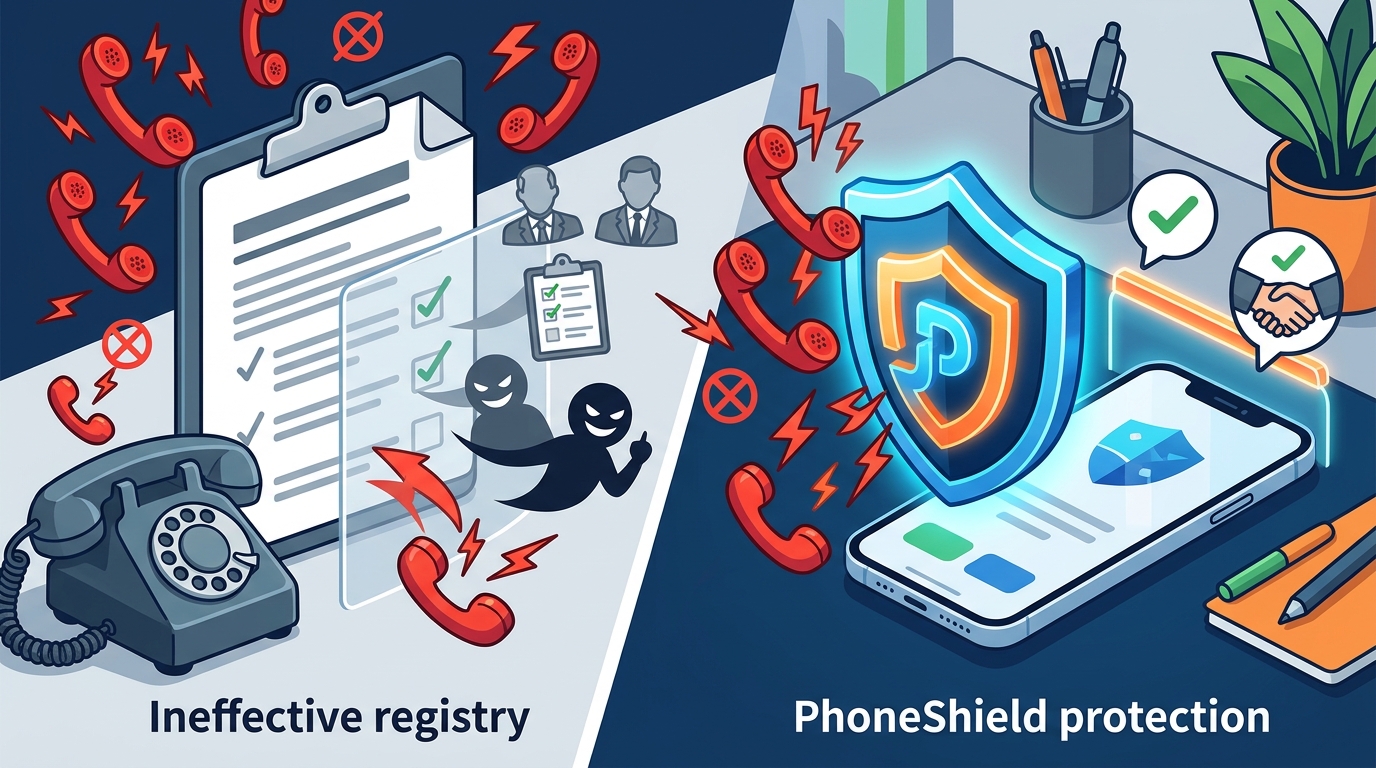
Registering with government do not call lists does not stop most robocalls. The Federal Trade Commission (FTC) National Do Not Call Registry only restricts telemarketers, not political, survey, or scam calls. Scammers ignore these rules entirely. PhoneShield.ai provides a technical shield that blocks these calls before they ring, offering a practical solution where government lists fail.
The Scope of the National Do Not Call Registry
The National Do Not Call Registry is a federal database maintained by the FTC. It is a list of phone numbers that telemarketers are legally prohibited from calling for commercial purposes. However, the registry has specific exclusions that limit its effectiveness for general call blocking. It does not cover political calls, survey calls, or calls from entities with which you have an established business relationship. Furthermore, it does not stop illegal robocalls or scam calls, which are the primary source of nuisance calls for most households.
According to the FTC, the registry is a tool for compliance, not a security filter. Telemarketers who comply with the rules must check the registry before placing calls. However, the vast majority of spam calls come from overseas call centers that do not respect U.S. regulations. These operators use spoofed caller IDs and automated dialing systems that bypass registry checks entirely. Therefore, while registration is a legal right, it is not a technical defense against the majority of unwanted calls.
Why Scammers Ignore Government Rules
Scam calls are a criminal activity, not a regulated marketing practice. The individuals and organizations behind these calls have no intention of complying with the National Do Not Call Registry. They operate from jurisdictions where U.S. law has no enforcement power. The cost of being caught is low compared to the potential profit from a successful fraud. This economic incentive drives the volume of calls that bypass government lists. The FTC has noted that the registry cannot stop these actors because they are not subject to the same compliance frameworks as legitimate businesses.
PhoneShield.ai addresses this gap by using a shared scam list and AI screening. Instead of relying on a static government database, the service analyzes call patterns and known fraud signatures in real-time. This approach is necessary because the threat landscape changes daily. New scam scripts and numbers appear constantly, requiring a dynamic defense rather than a static registry entry. The implication is that users must look beyond government tools for actual protection.
The Limitations of State-Level Registries
Some states maintain their own do not call lists, but these face the same fundamental limitations as the federal registry. State lists are typically smaller and less comprehensive. They also do not cover interstate or international calls, which make up a significant portion of robocall traffic. The enforcement of state lists is often weaker than federal enforcement, making them even less effective. For users in states with active registries, registration is still a good practice, but it should not be viewed as a primary defense mechanism.
The data from the FCC indicates that the majority of robocalls originate from outside the United States. These calls enter the U.S. network through various carriers and are often spoofed to appear local. State and federal registries cannot track or block these calls effectively. The only way to stop them is at the device or network level, where technical filters can identify and reject the call before it reaches the user. This is where services like PhoneShield.ai come in, providing a layer of protection that government lists simply cannot offer.
Technical Solutions vs. Regulatory Lists
Technical call blocking solutions operate on a different principle than regulatory lists. They use machine learning and pattern recognition to identify suspicious calls. These systems can detect spoofed numbers, automated dialing patterns, and known scam scripts. Unlike the National Do Not Call Registry, which is a passive list, technical solutions are active filters. They can block calls in real-time, regardless of the caller's location or intent. This makes them far more effective against the types of calls that actually bother users.
PhoneShield.ai uses a front-desk screening model to handle calls that pass initial filters. This model asks callers to identify themselves and their purpose, which most scammers are unwilling to do. This interaction serves as a final check before the call reaches the user. The combination of pre-answer blocking and post-answer screening provides a comprehensive defense. It is a practical alternative to relying on government lists, which are often too slow and too narrow to be useful.
Key Takeaways
- The FTC National Do Not Call Registry only restricts commercial telemarketers, not scam or political calls.
- Scammers ignore government lists because they operate outside U.S. jurisdiction and face low enforcement risks.
- State-level registries have similar limitations and do not cover international or spoofed calls.
- Technical solutions like PhoneShield.ai use real-time analysis to block calls that government lists miss.
- Registration with government lists is a legal right but not a reliable security measure.
- Active filtering and AI screening are necessary to stop the majority of modern robocalls.
Frequently Asked Questions
Does the National Do Not Call Registry stop scam calls?
No, the registry does not stop scam calls. It only restricts legitimate telemarketers from calling registered numbers. Scammers are not required to comply with the registry and often ignore it entirely.
Is it worth registering with the FTC do not call list?
Yes, it is worth registering because it is free and legally required for telemarketers to respect. However, it should not be your only defense against robocalls. It will not stop the majority of spam and scam calls you receive.
Can I block calls from specific countries using government lists?
No, government lists do not allow you to block calls based on country of origin. They only restrict commercial telemarketing. To block international calls, you need a technical solution that can identify and filter based on caller ID and network data.
Why do I still get robocalls after registering?
You still get robocalls because most of them come from scammers who do not follow U.S. laws. These calls are not subject to the National Do Not Call Registry. You need a technical blocking service to stop them.
Does PhoneShield.ai work with the do not call registry?
PhoneShield.ai complements the registry by providing technical blocking. It does not replace the need to register with the FTC, but it adds a layer of protection that the registry cannot provide. It blocks calls that the registry misses.
Conclusion
Government do not call lists are a necessary but insufficient tool for stopping robocalls. They restrict legitimate telemarketers but do nothing to stop the scammers who make up the bulk of unwanted calls. For real protection, you need a technical solution that can identify and block these calls in real-time. PhoneShield.ai offers this capability, providing a shield that works where government lists fail. To secure your phone, visit PhoneShield.ai and set up your protection today.