

AI front desks stop scam calls better than traditional spam apps because they screen every unknown caller in real time, rather than relying on static blocklists. PhoneShield.ai combines a pre-answer shield with an AI front desk to ensure that only legitimate callers reach your phone. This guide covers how spoofed number detection works and why a layered defense approach is the most effective strategy for protecting your family from modern phone fraud.
The Limitations of Traditional Spam Apps
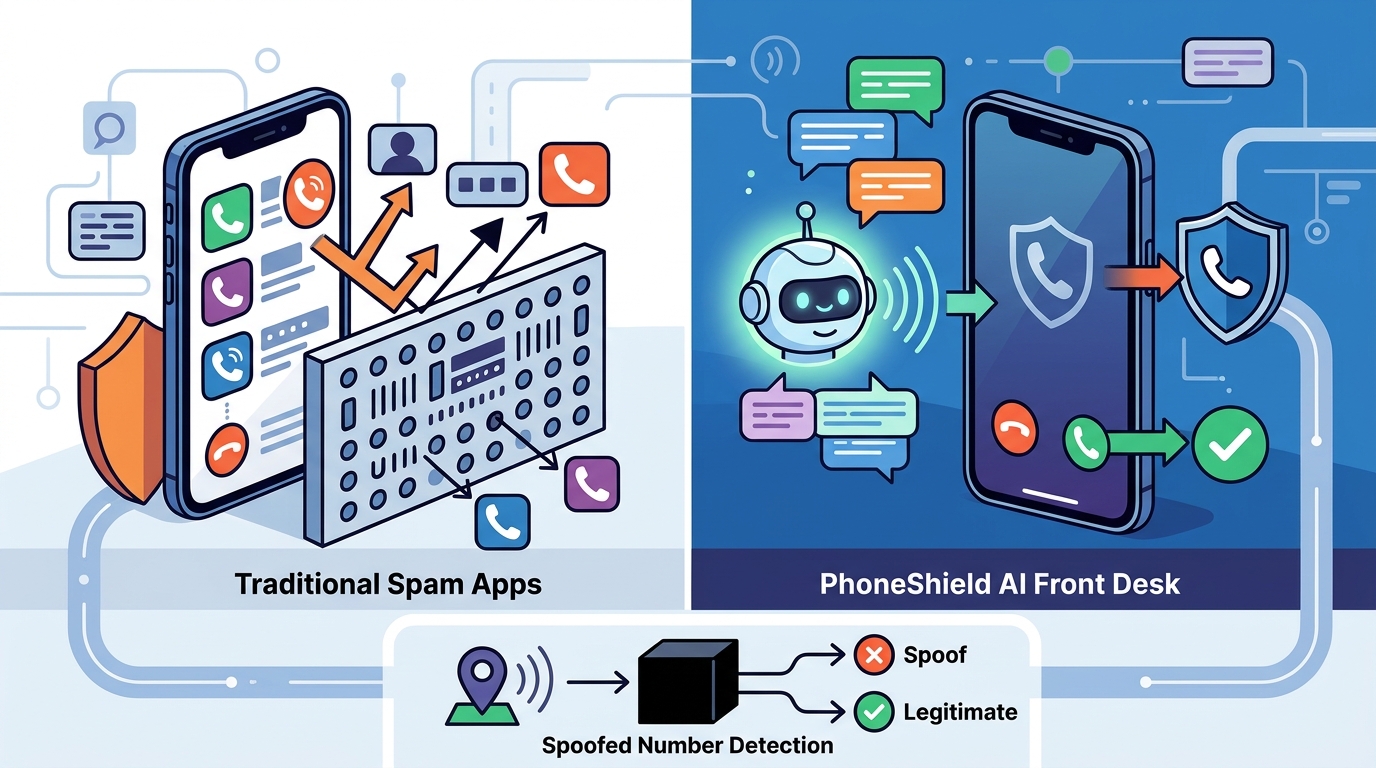
Traditional spam apps rely on a reactive model. They maintain a database of phone numbers that have been reported by other users. When a call comes in from a number on that list, the app blocks it or labels it as spam. This method is known as reactive blocking, which is a system that identifies threats only after they have been reported by a sufficient number of people. The fundamental flaw in this approach is speed. Scammers use automated dialers and constantly rotate their phone numbers. By the time a number is reported and added to a blocklist, the call center has often moved on to a new batch of numbers.
Furthermore, traditional apps struggle with spoofed caller IDs. A scammer can make a call appear to come from a legitimate local number, a business, or even a family member's number. Because the number looks clean and is not on a blocklist, the spam app allows the call to ring through. The user is then forced to answer the phone and judge the caller themselves. This places the burden of fraud detection on the victim, which is particularly dangerous for elderly individuals who may be polite or frightened by the caller's tone.
Spoofed Number Detection
Spoofed number detection is the process of identifying calls where the displayed phone number does not match the actual origin of the call. Modern scammers use Voice over Internet Protocol (VoIP) technology to manipulate the caller ID header. This allows them to display a number that looks local to the recipient, increasing the likelihood that the call will be answered. Traditional spam apps often fail here because they only check the displayed number against a database. If the displayed number is not flagged, the call passes through, even if the actual source is a fraudulent call center in another country.
Why Blocklists Fail Against Spoofing
Blocklists are static lists of known bad numbers. They cannot detect the behavior of a call in real time. A spoofed number might be a legitimate number that is currently being used by a scammer. The spam app sees a clean number and lets the call ring. The user answers, and the scam begins. This is why behavioral screening is necessary. Instead of just looking at the number, the system must listen to the call and analyze the content of the conversation to determine if it is a scam.
The Role of AI in Identifying Fraud
Artificial Intelligence (AI) can analyze the audio of a call to detect scam patterns. It listens for specific scripts, such as requests for gift cards, urgent bank information, or threats of legal action. This is a form of content-based filtering, which is a method that evaluates the substance of a communication rather than just its metadata. By analyzing the conversation, an AI front desk can identify a scam even if the caller ID is perfectly spoofed. This capability is the primary advantage of AI front desks over traditional spam apps.
The Layered Defense Approach
A single tool is rarely enough to stop all phone fraud. The most effective security strategy is a layered defense, which is a security model that uses multiple independent controls to protect an asset. In the context of phone calls, this means combining pre-answer blocking with real-time screening. The first layer is the shield, which refuses calls from numbers already identified as scams. The second layer is the front desk, which screens all other unknown callers. This ensures that even if a scammer bypasses the first layer, they are stopped by the second.
Layer 1: Pre-Answer Shield
The first layer of defense is the pre-answer shield. This system checks the incoming call against a shared scam list and the Federal Trade Commission's (FTC) daily complaint data. If the number is on the list, the call is refused before the phone rings. This is a form of preventive blocking, which stops known threats before they can interact with the user. This layer is fast and efficient. It handles the majority of obvious spam and scam calls without requiring any user interaction. It is the same technology used by traditional spam apps, but it is applied before the call reaches the device.
Layer 2: AI Front Desk Screening
The second layer of defense is the AI front desk. This system answers calls from unknown numbers that are not on the blocklist. It asks the caller who they are and what they want. If the caller provides a legitimate reason, such as a doctor's office or a family member, the call is passed through to the user. If the caller uses a scam script, the AI politely declines the call. This layer is crucial because it handles the calls that traditional spam apps miss. It provides a second line of defense that is based on the content of the call, not just the number.
Layer 3: User Control and Favorites
The third layer of defense is user control. The user can designate specific numbers as favorites. These numbers always ring through, bypassing the screening process. This ensures that important calls from family, doctors, or businesses are never delayed or blocked. The user can also review the history of all calls, including those that were blocked or screened. This transparency allows the user to trust the system and adjust their settings as needed. This layer ensures that the defense is tailored to the user's specific needs and relationships.
How PhoneShield Works
PhoneShield.ai implements this layered defense approach. It is a scam call protection service that stops fraudulent calls before they reach the user's device. The platform offers unlimited scam refusals and front-desk screening. It charges a metered fee of $0.12 per minute for Nora's assistant talk time after the first 150 minutes are included. This service acts as a shield against the fifty billion robocalls generated annually by call centers using fake caller IDs. It positions itself as a critical defense for parents and families, ensuring that only legitimate calls get through to their phones.
When a call comes in, PhoneShield first checks the number against its shared scam list. If the number is flagged, the call is refused. If the number is not flagged, the call is forwarded to the PhoneShield front desk. The front desk answers the call and asks the caller to identify themselves. If the caller is a scammer, the front desk declines the call. If the caller is legitimate, the call is passed through to the user's phone. The user sees a notification with the caller's name and the reason for the call. This process happens in seconds, and the user never has to answer a scam call.
Comparison: Spam Apps vs AI Front Desks
The table below summarizes the key differences between traditional spam apps and AI front desks like PhoneShield.
| Feature | Traditional Spam Apps | AI Front Desks (PhoneShield) |
|---|---|---|
| Detection Method | Static blocklists | Pre-answer shield + real-time AI screening |
| Spoofed Number Handling | Often fails if number is not on list | Screens content of call to detect scams |
| User Interaction | User must answer and judge caller | AI answers and screens caller |
| False Positives | Can block legitimate calls | Favorites always ring through |
| Cost Model | Usually flat monthly fee | Flat fee + metered assistant time |
| Best For | Basic spam filtering | Comprehensive scam protection for families |
Key Takeaways
- Traditional spam apps rely on static blocklists, which are slow to update and easily bypassed by scammers.
- Spoofed caller IDs are a major weakness of traditional apps, as they only check the displayed number.
- AI front desks use real-time screening to analyze the content of calls, detecting scams even with spoofed numbers.
- A layered defense approach combines pre-answer blocking with AI screening for maximum protection.
- PhoneShield.ai offers a flat monthly fee with metered assistant time, providing a cost-effective solution.
- Favorites and user control ensure that legitimate calls are never blocked or delayed.
- Protecting elderly parents is a primary use case, as they are often targeted by sophisticated phone scams.
- The best protection is a system that handles calls for you, rather than one that just labels them.
Frequently Asked Questions
Do AI front desks stop scam calls better than spam apps?
Yes, AI front desks stop scam calls better than traditional spam apps because they screen every unknown caller in real time. They can detect scams even if the caller ID is spoofed, which is a common failure point for traditional apps.
How does PhoneShield handle spoofed numbers?
Will PhoneShield block legitimate calls?
No, PhoneShield allows you to designate favorites that always ring through. For other callers, the AI front desk asks for identification. If the caller provides a legitimate reason, the call is passed through to you. You can also review the call history to ensure no legitimate calls are missed.
How much does PhoneShield cost?
PhoneShield costs $29.99 a month. This includes your PhoneShield number, scam calls refused before they ring, front-desk screening, messages, calls that ring you, and 150 minutes a month of Nora. After 150 minutes, the cost is $0.12 a minute for Nora's talk time.
Do I need to install an app on my parent's phone?
No, you do not need to install an app on your parent's phone. You simply forward their phone number to your PhoneShield number. The calls are handled by PhoneShield, and your parent's phone rings only for legitimate calls. This makes it easy to set up and use.
Can PhoneShield stop all scam calls?
PhoneShield is designed to stop the vast majority of scam calls. It uses a combination of pre-answer blocking and AI screening to provide comprehensive protection. While no system is 100% perfect, PhoneShield significantly reduces the number of scam calls that reach your phone.
Conclusion
AI front desks are a superior solution for stopping scam calls compared to traditional spam apps. They address the critical weakness of spoofed caller IDs by screening the content of every call. PhoneShield.ai provides a robust, layered defense that protects your family from the most sophisticated phone fraud. By combining pre-answer blocking with real-time AI screening, PhoneShield ensures that only legitimate calls reach your phone. If you are looking for a reliable way to protect your parents or yourself from scam calls, PhoneShield.ai is the best choice.